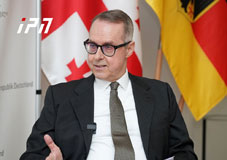
German Ambassador: No High-Level Georgia-EU Talks as "Positive Agenda" Disappears
By Liza Mchedlidze
Thursday, February 12, 2026
There have been no recent high-level meetings between Georgia and its Western partners because there is no positive agenda, German Ambassador to Georgia Peter Fischer said in an interview with InterpressNews, warning that Georgia's EU path is effectively stalled due to the current political course.
"You probably have noticed that there haven't been any high-level meetings recently. High-level meetings happen when there's a positive agenda, when there's something positive to be done, and right now, we don't have a positive agenda," Fischer said.
Fischer said his long-standing personal and professional relationships with Georgian Dream leaders have deteriorated amid what he described as an official narrative portraying Germany and the European Union as hostile.
"We had toasts to friendship, partnership, Georgia's European future-everything was wonderful. Now many of them don't want to be my friends anymore," he said. "I have the feeling it's no longer opportune to be seen with me because of this crazy narrative that Germany and the European Union are bad."
He stressed that the attacks are not personal. "This is an attack on the ambassador of the Federal Republic of Germany. There could be someone else sitting in my chair," Fischer said.
Fischer confirmed that Germany recalled him from Georgia for several weeks in October 2025 as a formal diplomatic protest.
"I wasn't summoned. I was recalled for consultations. Recalled for consultations is a fixed diplomatic term to express protest or disagreement," he said.
According to Fischer, the main reasons were "continued disinformation attacks against Germany, against the European Union and against the ambassador," as well as concerns over recent legislative developments in Georgia.
He said Berlin's instruction upon his return was clear: "Make sure and make clear that the door remains open for Georgia to join the EU. The candidate's status does not go away."
At the same time, he warned that distancing from the EU would inevitably downgrade relations.
"As you approach the EU, it's more for more. As you distance yourself, it's less for less," Fischer said. "If Georgia chooses another path, Germany will have to adjust its relations. Compared to joining the EU, it will be a downgrade."
Fischer said Germany and the EU already assess that Georgia has violated human rights and international commitments in connection with demonstrations in late 2024 and early 2025.
He explained that Georgia's status as an OSCE participating state comes with clear obligations.
"Human rights and fundamental freedoms are of immediate concern to all participating states and do not belong to the exclusive area of internal affairs," he said.
After an unsatisfactory response from Georgia under the OSCE Vienna Mechanism, Fischer said 23 states, including Germany, activated the Moscow Mechanism, triggering an expert mission.
"The scope of the expert mission is quite long. It includes the demonstrations in both 2024 and early 2025," he said.
Fischer urged Georgians to have realistic expectations about sanctions, stressing that they require a strict legal basis.
"We can't impose sanctions just because we don't like someone. That's illegal," he said. "There has to be hard evidence that would stand up in court."
He added that sanctions are not a quick fix. "Look at Russia, Iran, North Korea-sanctions are not a solution to everything."
Fischer listed the growing international consequences Georgia is facing, including criticism from the UN Human Rights Council, suspension from the Parliamentary Assembly of the Council of Europe, visa-related measures, and the standstill in EU accession.
"So everybody's wrong? The OSCE is wrong, the United Nations are wrong, the Council of Europe is wrong, and the EU is wrong?" he asked. "Is that possible?"