Prepared by Messenger Staff
Geneva Talks End Without Breakthrough as Divisions Persist
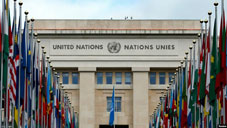
The 66th round of the Geneva International Discussions was held in Switzerland on March 18 and 19, bringing together higher-level diplomats than in recent sessions. The format, established after the 2008 Russia-Georgia war, remains the main channel for addressing security and humanitarian issues linked to the conflict.
The talks were co-chaired by the European Union, the United Nations, and the OSCE. The United States sent Deputy Assistant Secretary of State Sonata Coulter, while the UN delegation was led by Assistant Secretary General Mohamed Khaled Khiari. Georgian Dream Deputy Foreign Minister Lasha Darsalia led Tbilisi's delegation, while Russia was represented by Deputy Foreign Minister Mikhail Galuzin.
In the security discussions, Georgia called on Russia to implement the 2008 ceasefire agreement and raised concerns about conditions in occupied Abkhazia and South Ossetia. Russia and representatives from the two regions focused on securing a non-use-of-force agreement and pushed for the delimitation of what they consider state borders, which Georgia rejects.
Humanitarian talks covered missing persons, education, and healthcare, but again stalled over the return of displaced persons and refugees. Representatives from the Russian-backed authorities walked out when the issue was raised, accusing Georgia of politicizing it through UN resolutions.
Despite the walkout, participants confirmed their commitment to continuing the Geneva format. The Incident Prevention and Response Mechanism in Ergneti will remain in use to manage tensions on the ground. The next round of discussions is scheduled for June 2026.
Georgia's Economy Grows 7.5% in 2025
Preliminary data from the National Statistics Office of Georgia show that Georgia's gross domestic product reached 104.6 billion GEL in 2025, marking a 12.4% increase in nominal terms compared to the previous year. Real economic growth stood at 7.5%, while the GDP deflator rose by 4.6%.
The largest shares of the economy were held by trade and vehicle repair at 14.8% and real estate at 9.3%. Manufacturing accounted for 9.1%, followed by information and communication and construction at 8.0% each. Public administration and defense made up 6.7%, education 6.4%, transport and storage 6.1%, and agriculture 5.9%.
Growth was driven primarily by strong expansion in information and communication at 28.7% and education at 24.5%. Other contributing sectors included financial and insurance activities, public administration, transport, trade, and real estate.
Agriculture and energy supply recorded declines, with output falling by 5.7% and 4.5%, respectively.