Council of Europe Rights Commissioner Challenges Georgia's Foreign Agents Law
By Messenger Staff
Wednesday, September 9, 2026
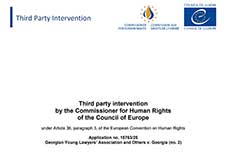
Council of Europe Commissioner for Human Rights Michael O'Flaherty has intervened in a case before the European Court of Human Rights challenging Georgia's Foreign Agents Registration Act, saying the law is part of a wider pattern of restrictions on civil society.
O'Flaherty submitted his observations to the Strasbourg-based court as a third party in the case, which was brought by a group of Georgian non-governmental and media organisations, including the Georgian Young Lawyers' Association (GYLA).
Georgia's FARA, which entered into force on April 1, 2025, requires organisations and individuals receiving foreign funding and deemed to be involved in "political activities for or in the interests" of a foreign principal to register as foreign agents. Failure to comply can lead to criminal penalties.
The organisations filed their application with the European Court of Human Rights in September 2025. GYLA said in April that the court had begun examining the case.
In observations published on September 8, O'Flaherty said the law should be viewed alongside other measures adopted by the Georgian authorities.
"The enactment of the Georgian FARA on 1 April 2025 forms part of a broader pattern of restrictive measures intended to intimidate CSOs who are perceived as critical of the government," he said.
"The aim of the Georgian FARA may have been to discredit civil society activists," he added.
O'Flaherty said FARA had not replaced Georgia's 2024 Law on Transparency of Foreign Influence, commonly known as the Foreign Agents Law, but operated alongside it. He also pointed to subsequent restrictions affecting foreign grants, foreign funding for broadcasters, civil society participation in public decision-making, freedom of assembly and freedom of expression.
The commissioner raised concerns about the scope and wording of FARA, saying its definition of political activity was too broad.
"Georgian FARA defines 'political activity' expansively to cover virtually any activity aimed at shaping domestic or foreign policy or political attitudes," O'Flaherty said.
He said the wording blurred the distinction between legitimate international cooperation and foreign interference, making it difficult for organisations and individuals to determine whether the law applied to them.
The law, he said, "appears to target broad categories of legitimate actors for ulterior purpose of discouraging civil society activity."
O'Flaherty also compared the level of state control created by the Georgian law with Russia's foreign agent legislation, saying FARA "creates a regime of pervasive administrative control that is comparable in intrusiveness to the Russian 'foreign agent' laws criticised by the Court."
He said the use of the term "agent" could itself damage the reputation of civil society groups.
"The enactment of the Georgian FARA has in itself had a significant stigmatising effect on the reputation of CSOs in Georgia," he wrote, adding that the effect was reinforced by government rhetoric describing civil society organisations and human rights defenders as "enemies of the state."
The commissioner argued that several provisions of the law were inconsistent with the European Convention on Human Rights, including its requirements of legality, legitimacy, necessity and proportionality.
He referred in particular to Articles 10 and 11, which protect freedom of expression and freedom of assembly and association, as well as Article 14, which prohibits discrimination.
In his concluding remarks, O'Flaherty said FARA was part of a wider series of measures affecting civil society and media organisations.
"The adoption of the Georgian FARA forms part of a broader pattern of restrictions on the rights to freedom of association and freedom of expression affecting civil society in Georgia," he wrote.
He said those restrictions had a "chilling effect" on media outlets and civil society organisations, including groups working on human rights, democracy and the rule of law.
"There are several aspects which call into question the Georgian FARA's declared purpose of ensuring the transparency of foreign influence regarding the funding of civil society organisations," O'Flaherty said.
This is not the first time the commissioner has intervened in proceedings concerning Georgia's foreign agent legislation. He previously submitted observations in another case before the European Court of Human Rights involving the country's 2024 Foreign Agents Law.