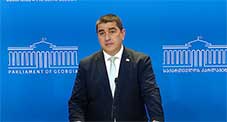
Papuashvili Says EU Policy Toward Georgia Is at a Dead End
By Messenger Staff
Thursday, September 10, 2026
Georgian Dream Parliament Speaker Shalva Papuashvili has criticized the European Union over its latest comments on Georgia, saying Brussels continues to promote claims that he considers false.
The remarks came after Michele Cervone d'Urso, the EU's deputy permanent representative to the United Nations, told a U.N. Human Rights Council session that the bloc was deeply concerned about the alleged political use of Georgia's judiciary and measures against civil society organizations. The EU also called for recently adopted legislation to be repealed or substantially revised, saying it undermines international human rights standards.
In a Facebook post, Papuashvili accused the EU of repeating claims about "arbitrary detentions" and "repressions" that, in his view, contradict the facts and the EU's own principles.
He also accused the EU of partly financing protests against the Georgian government, including campaigns that encouraged the use of "Molotov cocktails." Papuashvili further claimed that Brussels gave a "green light" to an attempt to overthrow the government on October 4 last year.
According to Papuashvili, that attempt failed, while the Georgian government and public defended the country's freedom, sovereignty and interests. He also rejected allegations of election fraud and a crackdown on peaceful rallies, pointing to investigations, court rulings, documentation and admissions by people involved in violent offenses.
"A lie cannot become the truth just because Brussels repeats it insistently, and a perpetrator cannot become a victim just because some EU official wants it that way," Papuashvili wrote.
He described the EU's policy toward Georgia as being at a "dead end" and compared Brussels to "a soldier who has not learned that the war is over and is still planning military operations."
Papuashvili called on the EU to abandon what he described as a false narrative surrounding events in Georgia and to stop what he called "aggressive rhetoric" toward the country. He also urged Brussels to stop supporting what he considers a failed attempt to change the Georgian government.
For relations to improve, Papuashvili said, the EU should return to what he described as basic diplomatic principles: "respect for facts, Georgia's sovereignty, and the democratic choice of the Georgian people."