Georgia to Close State Grant Management Agency by Year-End, Kobakhidze Says
By Messenger Staff
Friday, September 18, 2026
Georgia will close its State Grant Management Agency by the end of the year, Georgian Dream Prime Minister Irakli Kobakhidze said on Thursday, September 17, as the government continues to restrict the role of non-governmental organizations.
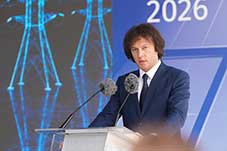
"The agency is in the process of winding down operations and will be closed by the end of the year," Kobakhidze told reporters after an event marking Energy Worker's Day.
The agency was established in April 2025 as the government introduced new restrictions on foreign funding for civil society organizations. Authorities said at the time that the agency would provide an alternative source of funding from the state budget.
Kobakhidze said the decision to close it was linked to his broader criticism of NGOs, which he accused of serving as channels for foreign political influence.
"An NGO is an artificial phenomenon that was invented artificially for the purpose of foreign political intervention," he said.
"A century ago, NGOs did not exist. They were subsequently invented, and NGOs were used as the principal instrument of foreign political intervention," Kobakhidze said, adding that Georgia had seen "numerous examples" of such involvement.
He said the state should not establish and finance organizations that could be used for foreign political purposes.
"Accordingly, for us to create NGOs ourselves and fund such things would be wrong. Therefore, we made this decision," he said.
Tamar Oniani, chairperson of the Georgian Young Lawyers' Association, criticized both the agency's closure and Kobakhidze's comments about NGOs.
Oniani said the government was targeting organizations with the capacity to defend rights and hold authorities accountable.
"The regime is fighting against those who possess the organizational and institutional capacity to struggle for the attainment and preservation of rights, in other words, it is fighting against genuine human rights organizations," Oniani wrote on social media.
She rejected the argument that NGOs are a relatively recent phenomenon, pointing to Georgia's own history of organized civic activity.
"A century ago, neither the Strasbourg Court nor the modern international human rights protection system existed," Oniani wrote. She said the absence of such institutions in the past did not mean civil society organizations were unnecessary or illegitimate.
Oniani also referred to Ilia Chavchavadze's Society for the Spreading of Literacy Among Georgians as an example of organized civic activity in Georgia.
She argued that Kobakhidze's remarks reflected a broader view of state sovereignty centered on power rather than accountability.
"The phrase 'NGOs did not exist a century ago' implies that the system views sovereignty as power rather than accountability," Oniani wrote.
Oniani also questioned the government's decision to abolish the grant agency after previously presenting state funding as an alternative for civil society organizations affected by restrictions on foreign financing.
She said the agency's operation and planned closure had exposed what she described as the superficial nature of a 2024 government position that activities such as strengthening democratic institutions, fighting corruption, supporting people with disabilities, protecting the environment and safeguarding minority rights could be recognized as legitimate when financed from the state budget.