Opposition Challenges Georgian Dream's Legal Arguments in Party Ban Case
By Messenger Staff
Friday, October 30, 2026
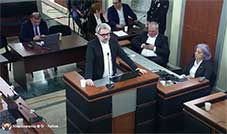
Opposition representatives challenged the case for banning five political parties during a Constitutional Court hearing, arguing that the legal criteria cited by the plaintiffs could also apply to the ruling Georgian Dream party.
Nika Gvaramia, representing the Coalition for Change, said that if the law were interpreted according to the plaintiffs' own arguments, Georgian Dream would be the party most likely to meet the criteria for a ban.
"According to the plaintiffs' own interpretation, the criteria describe a governing force that alters the constitutional course, punishes the opposition, and forcibly suppresses protests far more accurately than they describe an opposition that demands elections, justice, and freedom for political prisoners," Gvaramia said.
He also questioned why the plaintiffs had cited judicial vetting as an example of an attack on the constitutional order. Gvaramia argued that vetting was intended to identify and remove corrupt judges through legal procedures, rather than undermine the Constitution.
"Vetting is, in fact, nothing more than an attack on corruption, an objective that I hope Georgian Dream still considers legitimate," he said.
Constitutional Court Chairman Revaz Nadaraia interrupted Gvaramia, urging him to avoid provocative remarks about the judiciary and remain focused on the case. "I have no information regarding corruption among judges," Nadaraia said, adding that Gvaramia should show respect for the judicial system and discuss his personal views on its structure elsewhere.
A separate dispute arose when Gvaramia defended his statement that he was proud of some of the work carried out by the previous government, in which he had served. Georgian Dream representative Archil Gorduladze objected, saying the hearing was not an appropriate venue for personal declarations.
"How long must we listen, Your Honor, to what Nika Gvaramia is proud of?" Gorduladze asked, urging the court to return to examining the claim.
Gvaramia responded that the plaintiffs had introduced the statement into the proceedings and that he had the right to explain its context. However, Nadaraia upheld the objection, saying Gvaramia had already been given a full opportunity to respond to the allegations.
Badri Japaridze, one of the leaders of Lelo-Strong Georgia, warned that the lawsuit could also have serious implications for Georgia's sovereignty, territorial integrity and foreign policy.
"If the Constitutional Court grants this claim, a policy of 'not provoking' Russia would effectively become a constitutional obligation," Japaridze said. "This implies that criticizing the occupier would be classified as sabotage, as a provocation of Russian aggression, and consequently, as unconstitutional."
Japaridze argued that such a ruling could shift responsibility for Russia's 2008 aggression onto Georgia and provide Moscow with a legal argument to support its position. He cited Article 78 of the Georgian Constitution, which requires state institutions to take all measures within their powers to ensure the country's integration into the European Union and NATO.
"This is the constitutional choice of the Georgian people, not a matter for the Kremlin to decide," he said, urging the court to reject the lawsuit.
The Constitutional Court is considering a claim seeking to declare five opposition parties unconstitutional. The plaintiffs argue that the parties threaten Georgia's constitutional order, while the opposition disputes the legal basis of the case and warns that a ban could undermine political pluralism and the country's constitutional commitments.