Opposition Criticises Minsk Talks With Russia, Warns of Move Towards Restoring Ties
By Messenger Staff
Friday, November 20, 2026
The November 19 meeting between Georgian and Russian officials in Minsk has drawn criticism from opposition politicians, who described it as a step towards restoring diplomatic relations with Moscow and warned of growing Russian influence. Opposition leaders questioned the purpose and location of the talks, arguing that Georgia was engaging with Russia without the involvement of its Western partners.
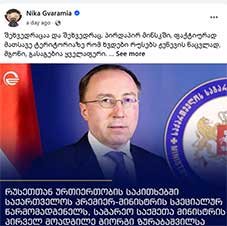
Nika Gvaramia, leader of the Coalition for Change, said the meeting between Giorgi Zurabashvili, Georgia's First Deputy Foreign Minister and Kobakhidze's Special Representative for Relations with Russia, and Russian Deputy Foreign Minister Mikhail Galuzin amounted to the restoration of diplomatic relations in practice.
"When the Deputy Minister of Foreign Affairs meets a representative of Russia, and meets in Belarus, this is called nothing other than the restoration of diplomatic relations," Gvaramia told journalists.
He argued that the government was formalising previously secret channels with Moscow and questioned why the meeting was held in Minsk if its purpose was strictly economic or trade-related. Gvaramia stressed that Zurabashvili was not a trade representative but an official responsible for relations with Russia, who was also expected to represent Georgia in the Geneva format.
He also criticised the choice of Belarus as the venue, describing it as part of an anti-Ukraine alliance. Gvaramia said the authorities had not clearly explained what was discussed at the meeting and argued that any trade-related talks could have taken place elsewhere.
"Diplomatic relations are not a name; diplomatic relations are real steps," he said, reiterating that the meeting represented a move towards restoring ties with Russia.
Another Coalition for Change leader, Zurab Girchi Japaridze, said the Minsk talks could eventually lead to the restoration of diplomatic relations and the opening of a Russian embassy in Tbilisi, which he described as Russia's potential third embassy on Georgian territory, alongside its missions in occupied Abkhazia and the Tskhinvali region.
"There is no 'representative of Kobakhidze' or 'representative of the Prime Minister'; both sides are Russia, and the meeting is taking place on Russian territory," Japaridze wrote on social media.
He questioned whether Georgian Dream officials could negotiate with Moscow independently, arguing that Georgia had failed to achieve results even within the Geneva International Discussions, where the United States, the European Union, the OSCE and the United Nations are involved.
Japaridze accused the Georgian Dream government of pursuing policies that have increased Georgia's economic and energy dependence on Russia while weakening its Western ties. He cited the suspension of EU and NATO integration, deteriorating relations with Western partners, pressure on pro-Western political and civil society groups, and what he described as the weakening of state institutions and the development of a Russian-style propaganda system.
He also accused Georgian Dream of shifting responsibility for the 2008 war onto Georgia, indirectly justifying Russia's occupation of around 20% of the country's territory. Japaridze further alleged that the government had stalled the Anaklia deep-sea port project to avoid competition with Russia's Novorossiysk port.
He called the Minsk meeting a logical continuation of these policies and urged citizens to attend a rally on November 28 at 7 p.m. near Tbilisi State University.
"This country will not be Russified!" he wrote.
Imprisoned United National Movement leader Levan Khabeishvili described the meeting as a "betrayal in Minsk," accusing the government of sending a Georgian representative to negotiate with Russia without the support of international partners.
"He wandered off alone to the Russians, and who?! Some nameless nobody! And where?! Practically on enemy turf!" Khabeishvili wrote on social media.
In a lengthy post, Khabeishvili warned that Georgia was heading towards international isolation and severe economic difficulties. He predicted rising fuel prices and exchange rates, restrictions on international trade and travel to Europe, and possible exclusion from international systems. He also claimed that, following the banning of opposition parties, the authorities would move against television stations and social media platforms and criminalise dissent.
Khabeishvili argued that the Georgian Dream government was moving towards eliminating political opposition and independent criticism, warning that Georgia could ultimately become what he called "Russia's Chechnya."