Prepared by Messenger Staff
Imprisoned Journalists Mzia Amaglobeli and Andrzej Poczobut Receive Sakharov Prize
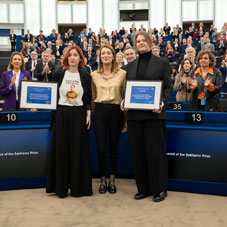
The European Parliament awarded the 2025 Sakharov Prize to imprisoned journalists Mzia Amaglobeli of Georgia and Belarusian journalist Andrzej Poczobut for their work defending human rights and freedom of expression. The prizes were received by Irma Dimitradze on behalf of Amaglobeli and by Poczobut's daughter, Jana Poczobut. Winners will each receive 50,000 euros.
European Parliament President Roberta Metsola said, "Andrzej and Mzia are not with us today, they are in prison, simply for doing their job, for speaking out against injustice and persecution."
In a letter read at the ceremony, Amaglobeli described repression in Georgia and called for European support. "Today, the movement towards the European Union is being responded to with repression in my homeland. I would like European leaders to use all the existing mechanisms at their disposal to influence autocratic rulers. I would like Georgian society, its aspirations for democracy and Europe to be protected, as they would protect the freedom of their own country," she wrote.
She also addressed ongoing threats from Russia, government crackdowns on protests, and attacks on journalists and opposition figures. "Our freedom does not depend on our struggle alone. We need the solidarity and support of you, the peoples of Europe and the free people of the civilized world," she said.
The Sakharov Prize, established in 1988, is awarded annually for contributions to human rights, democracy, and the rule of law.
EU High Representative Says Georgia's Policies Affect Accession Prospects
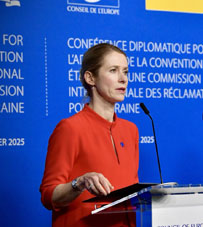
The European Union's High Representative for Foreign Affairs and Security Policy, Kaja Kallas, said Georgia's domestic policies are creating obstacles to the country's EU membership aspirations.
Speaking at a press conference, Kallas addressed a question from a journalist about EU and U.S. statements on Georgia's rhetoric toward European institutions. The journalist asked: "The EU has repeatedly stated that Georgia cannot become part of the EU under the rhetoric that it uses towards the European bureaucracy and the EU itself. Similar narratives are also reflected in the US National Security Strategy. What is your response to this, given that Washington's rhetoric now seems to be in line with these policies? Are you ready to accuse the Trump administration of following a script dictated by the Kremlin, if this reveals a fundamental double standard in your policy towards Georgia?"
Kallas responded by emphasizing the difference between Georgia and the United States. "The difference is that the United States is not trying to join the European Union. Of course, what we read in the National Security Strategy is not pleasant to read, but we have adopted the approach that we will not interfere in the internal politics of our allies," she said.
Turning to Georgia, Kallas said: "The main problem is that while on the one hand, Georgia declares that it wants to join the European Union and choose the European path, we see steps taken by the government in the wrong direction. This is a signal to the government that as long as they continue their policy of suppressing the opposition, pressuring free media, and other actions that contradict the values of the European Union, Georgia will have no future in the European Union."