EU Says Georgia's Accession at Deadlock as Kobakhidze Rejects Criticism
By Liza Mchedlidze
Thursday, December 18, 2025
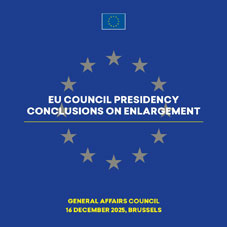
Georgia's path toward European Union membership has effectively stalled, with EU institutions warning of democratic backsliding and accusing the country's authorities of actions incompatible with candidate status, according to newly released conclusions adopted by the EU Council Presidency.
In the document, published in translation by the EU Delegation to Georgia, the Council states that the country's EU accession process has reached a deadlock until the authorities show a clear commitment to reversing course and returning to the EU integration path. The conclusions point to what the Council describes as a serious overall regression in democracy, human rights, and the rule of law.
"The Council reiterates the EU's support for the European aspirations of the overwhelming majority of the Georgian population," the document says. At the same time, it adds that "the actions taken by the Georgian authorities do not meet the EU's expectations of an EU candidate country."
The Council lists a wide range of concerns, including the adoption of what it calls repressive legislation undermining fundamental rights and freedoms, the use of the judiciary for political purposes, the persecution of opposition leaders, and the unjustified detention of protesters and journalists. It also highlights a shrinking space for civil society and condemns what it describes as the dissemination of disinformation and anti-EU narratives by the Georgian authorities.
"The Council condemns the dissemination of disinformation and narratives directed against the EU by the Georgian authorities and calls for an end to these practices," the statement says.
According to the document, Georgia has backtracked on commitments made under the nine steps that paved the way for the country to receive EU candidate status. "Accordingly, Georgia's EU accession process has effectively reached a deadlock until the authorities demonstrate a firm commitment to changing course and returning to the EU integration path," the Council concludes.
As initial steps toward re-engaging with the EU, the Council urges Georgian authorities to release all unjustly detained politicians, journalists, and activists, repeal repressive legislation, and pursue democratic, inclusive, and sustainable reforms in line with European values. It also calls on officials to stop using aggressive rhetoric toward the EU, EU ambassadors, and the head of the EU Delegation.
Despite the criticism, the Council reiterates its support for Georgia's sovereignty, independence, and territorial integrity within its internationally recognized borders, and reaffirms its commitment to the peaceful resolution of conflicts, including through the work of the EU Monitoring Mission in Georgia.
The conclusions also express regret over Georgia's failure to implement recommendations under the EU's visa suspension mechanism and call on the authorities to immediately meet visa liberalization benchmarks. In addition, the Council says it expects Georgia to intensify alignment with the EU's Common Foreign and Security Policy, particularly by joining EU restrictive measures against Russia and Belarus in the context of Russia's war against Ukraine. The statement urges Georgian authorities to refrain from actions that contradict EU foreign policy positions and to continue efforts to prevent the circumvention of EU sanctions.
Georgian Dream Prime Minister Irakli Kobakhidze sharply rejected the Council's conclusions, accusing European institutions of siding with what he described as anti-state forces. "I would describe this statement as assuming responsibility for criminal and anti-state actions that were carried out against the Georgian people and the Georgian state," Kobakhidze said when asked to comment on the report.
He argued that references to unjustified detentions mischaracterize the actions of law enforcement. "Those who were detained are people who were directly involved in revolutionary processes and attacks on state institutions," the prime minister said. "This means that European bureaucracy is assuming responsibility for these acts, acts directed against statehood and the constitutional order. If I were in the place of European bureaucracy, I certainly would not assume responsibility for such criminal acts."
Kobakhidze also defended controversial legislation criticized by the EU, referring specifically to the law on transparency of foreign influence. "As for the legislation, you know that the discussion concerns the transparency law, and there is no basis for criticism here," he said. "This law allowed us to call things by their proper names, and that was its main purpose."
He accused certain non governmental and civil society organizations of long standing anti state activity. "If I were in their place, I would not take responsibility for the anti state actions carried out over all these years by certain organizations, so called NGOs and so called civil society organizations," Kobakhidze added.