Prepared by Messenger Staff
Georgian Dream Parliament Adopts Controversial Laws as Fall Session Concludes
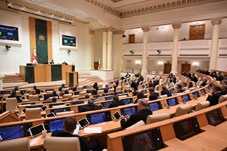
The disputed Georgian Dream-led parliament is wrapping up its fall session after passing a series of controversial laws during an extraordinary plenary session on December 17, prompting criticism over the speed and scope of the changes.
Lawmakers approved legislation ending voting rights for Georgians abroad, abolishing the Anti Corruption Bureau and the Personal Data Protection Service, dismantling the business ombudsman's office, and eliminating the so-called South Ossetia provisional administration. The extraordinary session, held in the final week of the fall term, will formally conclude with a bureau meeting on December 19.
One of the most contentious measures was a revised election code that restricts voting to Georgia's territory, effectively stripping citizens living abroad of the right to vote. The amendments were adopted with 79 votes in favor and 11 against. Georgian Dream has defended the change as a safeguard against foreign interference, while critics say it disenfranchises the diaspora, estimated at over one million people. In the 2024 election, only 34,574 Georgians abroad were able to vote, and the ruling party secured just 13 percent of the overseas vote.
Parliament also approved legislation abolishing the Personal Data Protection Service and the Anti Corruption Bureau, both set to cease operations in March 2026. The Anti-Corruption Bureau, created in 2022 as part of EU candidate status requirements, was widely criticized for being used against government critics, including NGOs and media outlets. Its functions will be transferred to the State Audit Office.
In a final reading, lawmakers voted to abolish the South Ossetia provisional administration, established in 2007, annulling laws related to conflict resolution and property restitution in the former South Ossetian Autonomous District. The body will be dissolved by January 1, 2026.
The session also saw the adoption of amendments to juvenile justice legislation allowing children aged 10 to 18 who committed offenses before turning 14 to be placed in family-type care facilities for renewable six-month periods, up to two years. Authorities say the measure is rehabilitative, while critics warn it risks stigmatizing minors.
Kobakhidze Accuses EU of Double Standards Over Sanctions Against Russia
Georgian Dream Prime Minister Irakli Kobakhidze has accused the European Union of applying double standards to Georgia, particularly regarding pressure to adopt sanctions against Russia.
"There are prime ministers of certain countries who can fly from Europe to Moscow. We have nothing against that; it is the business of those countries. But the double standards we see from European bureaucracy are very bad," Kobakhidze said, calling the EU's approach toward Georgia "shameful."
He said the EU initially avoided pressing Georgia on sanctions, mentioning the issue only in a European Parliament resolution, but is now demanding action. "Even the executive branch is directly demanding that we join the sanctions, which fully exposes everything," he said.
Kobakhidze cited the economic consequences of joining sanctions, noting that in March 2022, calculations showed it could cause at least a 10 percent decline in the Georgian economy. "There was no justification for this, so we made our decision in line with national interests," he said.
He added that similar demands have not been made of other EU candidate countries, such as Moldova or Armenia. "In one case, something may be acceptable, while in another case, a situation ten times less significant may provoke a sharply negative reaction. The double approach the European Union demonstrates toward Georgia is shameful," Kobakhidze said.