European Parliament Debates Georgia's Democratic Crisis, Calls Grow for Investigation and Sanctions
By Liza Mchedlidze
Friday, December 19, 2025
Members of the European Parliament held a heated debate on December 17 on what they described as a deepening democratic crisis in Georgia, focusing on human rights concerns, stalled EU accession prospects, and allegations that Georgian police used dangerous chemical agents against protesters.
The discussion took place during a critical week for EU decision-making on Georgia, alongside a Council meeting and ahead of an EU summit, amid growing scrutiny over Tbilisi's political trajectory. Most speakers sharply criticized the Georgian Dream government, while a smaller group of lawmakers defended the authorities and accused EU institutions of overreach.
Representing the European Council, Danish Minister for European Affairs Marie Bjerre stated that the bloc has repeatedly raised serious concerns about democratic backsliding in Georgia. She cited problems including pressure on independent media, politically motivated detentions, disinformation campaigns, and what she described as unacceptable conduct surrounding recent elections.
"Georgia's actions fall short of what we expect from a candidate country," Bjerre said, adding that the country has moved backward on all key reform benchmarks linked to EU candidate status. As a result, she said, the accession process has effectively stalled until authorities demonstrate a clear change of course.
Bjerre also praised Georgian citizens who have been protesting peacefully for more than a year. "Their courage is a reminder that European values are alive in Georgia," she said.
European Commissioner Michael McGrath echoed those concerns, warning that the scale of democratic and human rights regression in Georgia is unprecedented among EU candidate countries. Referring to the EU's latest enlargement report, he said authorities in Tbilisi have undermined the rule of law, restricted civic space, and adopted legislation incompatible with European standards.
"I urge the Georgian authorities to reflect, rebuild trust and return to the EU path," McGrath said, noting that the EU has increased financial support for Georgian civil society and independent media despite what he called an increasingly repressive environment.
Several lawmakers focused on a recent BBC investigation alleging the use of a toxic chemical compound against protesters in 2024. Lithuanian MEP Rasa Jukneviciene called for an independent international inquiry, saying resistance to such an investigation suggests fear of accountability.
"We must help the struggling Georgian people, because Georgia is Europe," she said.
German MEP Tobias Cremer went further, arguing that confirmed use of chemical weapons against civilians would disqualify the current leadership from any European ambitions. He called for targeted sanctions against Bidzina Ivanishvili and officials involved in alleged abuses.
Others urged immediate punitive measures. Malik Azmani of Renew Europe said the EU has delayed too long and should impose targeted sanctions, including visa restrictions on Georgian Dream officials. "They must pay the price, not the Georgian citizens," he said.
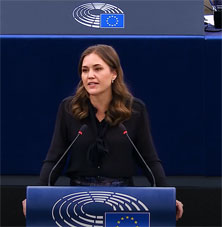
Green MEP Lena Schilling spoke about political prisoners and journalists, calling on the EU to match Georgian citizens' courage with decisive action. "Sanctions must hurt those who oppress people," she said.
A minority of speakers rejected the dominant narrative. French MEP Thierry Mariani accused EU institutions and NGOs of interfering in Georgia's internal affairs and undermining the legitimacy of its elected authorities. Czech MEP Ondrej Dostál argued that Georgia is a sovereign state and should be treated as a partner rather than pressured into compliance.