NGOs Ask International Bodies to Examine Alleged Use of Toxic Agents Against Protesters
By Liza Mchedlidze
Tuesday, December 23, 2025
A coalition of twelve Georgian civil society organizations has asked major international institutions to examine alleged abuses by law enforcement during protests in Tbilisi last winter, including claims that toxic and experimental substances were used against demonstrators.
The organizations said they have formally contacted the Organisation for the Prohibition of Chemical Weapons, United Nations special rapporteurs, and the Council of Europe's human rights commissioner, urging them to intervene and assess evidence related to multiple protest dispersals in late 2024.
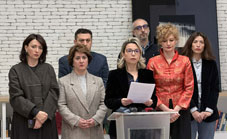
Reading a joint statement on December 22, Nino Lomjaria, head of the NGO European Orbit, said the groups are seeking an international response because domestic mechanisms have failed to provide credible answers.
"We have asked for international oversight to establish the truth and to protect the rights of those who were harmed," Lomjaria said. She added that those affected deserve clear information about what substances were used and the potential long-term health consequences.
According to the statement, the appeal is based on documented cases in which protesters suffered serious and lasting health effects after being exposed to substances dispersed during crowd control operations. The groups argue that some of the compounds used have not been clearly identified and may go beyond standard riot-control agents.
The appeal follows a recent BBC investigation that suggested Georgian police may have deployed a toxic compound dating back to World War I-era chemical agents during pro-EU demonstrations. The report reinforced concerns long voiced by protesters, doctors, and rights advocates who say many participants experienced symptoms that persisted well after the rallies ended.
The ruling Georgian Dream party rejected the allegations and criticized the BBC report, while state authorities acknowledged that chemicals were used but denied employing the substance identified by the investigation. Earlier this month, Georgia's State Security Service said police relied on CS gas during dispersals and stated that camite had never been purchased. Civil society groups argue that the investigation was rushed and incomplete.
"The official inquiry raised more doubts than answers," the NGOs said, asserting that Georgia lacks an independent and trustworthy mechanism capable of investigating such cases.
Calls for an external investigation have grown in recent weeks, including from European officials. Council of Europe Human Rights Commissioner Michael O'Flaherty previously noted inconsistencies between official assurances and later admissions by Georgian officials regarding the use of chemical additives in water cannons.
The NGOs said their goal is not only to clarify what happened in the past, but also to prevent similar actions in the future and ensure accountability in line with international law.