Kobakhidze Vows to 'Protect Media Freedom' Following UK Sanctions
By Messenger Staff
Thursday, February 26, 2026
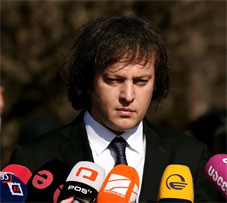
Georgian Dream Prime Minister Irakli Kobakhidze addressed the media regarding the United Kingdom's decision to sanction two Georgian television companies, Imedi TV and POSTV. He guaranteed that media freedom would be upheld and stated that the government takes full responsibility for ensuring journalists at these stations can continue their work without disadvantage.
While the UK government officially sanctioned the outlets for allegedly spreading Russian disinformation regarding the invasion of Ukraine, Kobakhidze argued that these measures would have no real-world impact in Georgia.
"The fundamental right to media freedom will be protected in both Imedi TV and POSTV, and we take full responsibility for this. No journalist will have a worse situation in any TV company; on the contrary, they will have full opportunity to exercise the fundamental right to media freedom and provide information to the public," Kobakhidze said.
Kobakhidze described the sanctions as a "shameful" and "tragic" move by European and British bureaucracy. He suggested that Great Britain, historically seen as a leader in human rights, no longer values those same principles.
"Historically and today, neither media freedom nor other basic human rights are valued in this country. The processes have led the European bureaucracy, including the British bureaucracy, to such a tragic situation, which is a very sad and tragic event," he stated.
Kobakhidze also compared the current situation to 2007, when Imedi TV faced restrictions under a previous administration. He noted that while those past violations were effective, the current sanctions are a "futile attempt" to restrict media freedom.
The UK's sanctions package includes freezing assets, a ban on financial management services, and the disqualification of the stations' directors. The British government maintains that the channels have deliberately spread misleading information about Russia's invasion of Ukraine to the Georgian public.
Despite these formal measures, Kobakhidze insisted that the Georgian government is the ultimate protector of human rights within its borders. He affirmed that since 2012, his administration has worked to end media monopolies and will continue to ensure that no journalist's rights are violated by international pressure.
"On paper, this is, of course, a violation of the basic right of media freedom, but in practice, it will have no effect. In this country, the state and the government are responsible for protecting basic human rights, including the basic right of media freedom," Kobakhidze added.