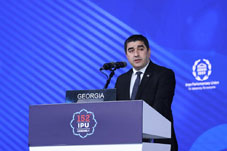
Papuashvili Demands Universal Rules Against Foreign Interference
By Messenger Staff
Friday, April 17, 2026
Shalva Papuashvili, the Speaker of the Georgian Dream-led Parliament, addressed the General Assembly of the Inter-Parliamentary Union (IPU) to demand a consistent international approach to national sovereignty. During his speech, he criticized the global community for applying "double standards" to laws designed to protect domestic political systems from external influence.
Papuashvili argued that international trust is being eroded by contradictory reactions to similar legislative frameworks.
"What is considered 'protection' in one country is regarded as a 'restriction' in another," Papuashvili stated. "What is praised in one system becomes a subject of criticism in another. This inconsistency undermines trust. If we take cooperation seriously, the rules must be the same for everyone."
He noted that while laws like the Foreign Agents Registration Act (FARA) in the United States or the Democracy Shield in the European Union are viewed as defensive measures, similar laws in other nations, such as Georgia's Foreign Influence Transparency Law, face condemnation. According to Papuashvili, these laws all share a single principle: "democracy must be shaped by the people, not by foreign power."
Papuashvili emphasized that national interest is the only sustainable foundation for a stable global order. He rejected the imposition of "abstract doctrines" or "artificial systems of values" that do not align with a nation's sovereign will.
"This is the only true compass of foreign policy," he said. "Any system that seeks to override national interest will ultimately collapse. Because what is not rooted in the people cannot endure."
Papuashvili warned that in an age of "information warfare and invisible influence," the defense of a nation is no longer restricted to its physical borders. He asserted that protecting the integrity of political institutions has become an essential duty for modern parliaments.
Papuashvili pointed to the South Caucasus as evidence that prioritizing sovereignty leads to peace. He observed that Georgia, Armenia, and Azerbaijan are becoming more stable because they are acting in line with their specific national interests.
To combat the "greatest threats" of hybrid warfare, he called for the international community to establish a legally binding framework that is "clear in principle, fair in application, and consistent in enforcement."
"Sovereignty cannot be selective, security cannot be one-sided," Papuashvili concluded.