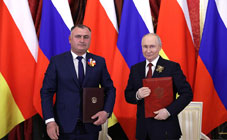
Putin and Tskhinvali's De Facto Leader Sign New Alliance Treaty
By Messenger Staff
Wednesday, May 13, 2026
Russian President Vladimir Putin and Alan Gagloev, the de facto leader of Georgia's Russian-occupied Tskhinvali region, signed a "Treaty on Deepening Allied Cooperation" in Moscow on May 9 during Victory Day events. Georgian Dream has yet to comment.
The treaty stipulates that Russia and the occupied region "shall expand cooperation with the aim of ensuring regional peace and stability, pursuing coordinated foreign policy and policies in the areas of defense and security, as well as border policy," along with harmonizing legal norms and creating conditions for the free movement of capital, goods, services, and labor. It also states that citizens of one side "may hold state and municipal positions" in the other.
Gagloev said the treaty "demonstrates that our close allied relations are reaching a new level of development" and described it as "another step toward the rapprochement of our countries and our peoples." Putin said it "will make it possible to further deepen our relations, primarily in trade and economic cooperation and in addressing social issues in the interests of the citizens of South Ossetia." On May 10, Putin submitted the treaty to the State Duma for ratification.
Oleg Gagloev, the region's de facto "labor minister," said the treaty "could potentially" allow Russian citizens to hold high-level posts in Tskhinvali, including in the de facto government or presidency, without South Ossetian "citizenship," and theoretically the reverse as well. "Frankly speaking, I cannot immediately recall other states where the level of trust and integration has been brought to such provisions," he said.
The document follows earlier treaties signed with the de facto authorities of both Tskhinvali and Abkhazia, including 2015 "alliance and integration" treaties that expanded Russia's influence over the two regions. Officials and observers have long raised concerns about Moscow's de facto annexation policies toward the occupied territories.
With the Georgian Dream silent, opposition politicians filled the void. Former MP Teona Akubardia slammed the government's silence as "a sign of consent, as well as evidence of the failure of a pragmatic policy toward Russia and a loss of sovereignty through this approach."