Council of Europe Assembly Report Warns Georgia Risks One-Party Dictatorship, Calls for Repeal of Repressive Laws
By Messenger Staff
Friday, May 22, 2026
A report on the functioning of democratic institutions in Georgia, prepared by two co-rapporteurs of the Parliamentary Assembly of the Council of Europe and adopted unanimously by the Monitoring Committee on May 18, 2026, warns that democratic backsliding in the country has continued unabated since the Assembly's last resolution and that the conditions for holding genuinely democratic elections do not currently exist in Georgia.
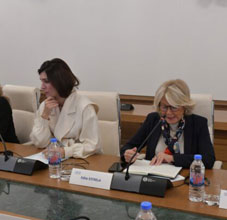
The report was prepared by co-rapporteurs Edite Estrela of Portugal and Sabina Cudic of Bosnia and Herzegovina. It covers the democratic environment, civil society, media, academia, freedom of assembly, police brutality, and the abuse of legal proceedings, and concludes with a draft resolution to be put before the full Assembly.
The rapporteurs found that since the adoption of Resolution 2624 (2025) on upholding democracy and the rule of law in Georgia, none of the Assembly's urgent recommendations had been addressed. They described the authorities' policies as "increasingly isolationist and antagonistic towards European organisations and their member States."
The report devoted significant attention to the Georgian Dream government's push to ban democratic opposition parties through the Constitutional Court. A parliamentary investigative commission, known as the Tsulukiani Commission, concluded in September 2025 that the United National Movement and its affiliated parties should be banned, which the report said would effectively cover practically the entire democratic opposition. The ruling majority subsequently appealed to the Constitutional Court to ban three key opposition movements: the UNM, Ahali/Coalition for Change, and Strong Georgia/Lelo. It later withdrew and refiled the appeal, a move the report said was widely believed to be aimed at resetting the nine-month legal deadline for the court to deliver a decision.
The rapporteurs said any initiative to ban democratic opposition parties and criminally prosecute their leadership "is unacceptable" and "would effectively establish a one-party dictatorship in Georgia, which violates essential democratic principles and is incompatible with Council of Europe membership."
The report also addressed the October 4, 2025, local elections, which were boycotted by most of the opposition and observed neither by international organizations nor by credible domestic observer organizations due to the crackdown on civil society. Georgian Dream won 81.7% of the vote with a turnout of 40.9%.
On election legislation, the report noted that the parliament had adopted amendments considered particularly advantageous for the ruling majority, including abolishing the right of the Georgian diaspora to vote abroad in December 2025, and adopting limitations on international observers in March 2026.
The report described a sustained assault on civil society organizations and independent media through controversial legislation. It said the Law on Grants adopted in April and June 2025 requires international donors, including Council of Europe member states, to obtain Georgian government approval before providing funds to Georgian civil society organizations, with violations resulting in fines of twice the amount received. It noted that the Venice Commission had concluded that the law "provides no clear and objective criteria for refusal and contains insufficient safeguards" and had recommended its repeal.
Further amendments adopted in March 2026 extended criminal liability for breaching the grants law, with prison sentences of up to six years, and barred any individual working for a "foreign agent" from joining a political party or an organization with declared party-political objectives for eight years.
Regarding media, the report cited the 2026 Reporters Without Borders Press Freedom Index, which ranked Georgia 135th out of 180 countries, down from 114th in 2025 and 103rd in 2024. It noted that amendments to the Law on Broadcasting, which introduced a blanket ban on foreign funding for broadcasters, "undermine media pluralism and fail the standards of necessity and proportionality," according to the Venice Commission.
Regarding academia, the report expressed concern over the academic reform's impact on intellectual freedom. It noted that the "One City, One Faculty" policy was forcing the closure of numerous university faculties, particularly at institutions where the student bodies had been most critical of the authorities.
The report said no credible investigations had been conducted into police brutality and human rights abuses committed during demonstrations, nor into the many reports of torture and ill-treatment of demonstrators during their arrest and detention.
It noted the Council of Europe's Committee for the Prevention of Torture report on its visits to Georgia in November 2024 and January 2025, which found that detainees "bore visible injuries, some of them severe and having required urgent medical attention" and described "a clear pattern of police behaviour during the demonstration: masked and hooded, unidentifiable police officers reportedly made arrests in groups, punching and kicking detained persons indiscriminately all over their bodies."
The report also addressed allegations that a First World War chemical agent called "camite" may have been used in water cannons to disperse protesters in Tbilisi, noting that the BBC published findings suggesting evidence of this in December 2025. The report said a former Georgian Minister of the Interior confirmed his ministry had previously purchased camite but ceased using it in 2012, and that Prime Minister Kobakhidze later admitted chemicals had been mixed into the water used by the water cannons, though he denied it was camite. The rapporteurs called for an independent and thorough investigation.
The report noted that the Council of Europe Human Rights Commissioner Michael O'Flaherty had written to Georgia's Prosecutor General in December 2025 over the lack of progress in investigations and had visited Georgia in April 2026, again calling for an independent investigation and expressing concern that the new Interior Minister, Sulkhan Tamazashvili, was the former head of the Tbilisi Police Department and had been sanctioned by several countries for his role in suppressing demonstrations.
The report also referenced a series of what it described as disproportionate and politically motivated sentences, including Nika Melia's additional 18-month sentence for throwing water at a presiding judge, and Elene Khoshtaria's one-and-a-half-year sentence for writing "Russian Dream" on a Georgian Dream campaign banner, which the prosecutor valued at approximately 182 euros.
The report pointed to a series of European Court of Human Rights judgments against Georgia, including the grand chamber judgment in Tsaava and Others v. Georgia, which found violations of the prohibition of torture, freedom of expression, and freedom of assembly during the 2019 protest dispersals. It said the Georgian authorities had used this judgment as a justification for charging former Prime Minister Gakharia. It also noted the January 2026 Mekvabishvili v. Georgia judgment, in which the court found Georgia had violated the right to a fair trial and freedom of assembly when it convicted a protester during the 2023 demonstrations under the foreign agents law, finding the authorities had failed to demonstrate "relevant and sufficient grounds to disperse the demonstration."
The draft resolution calls on the Georgian authorities to immediately repeal their Constitutional Court appeal to ban democratic opposition parties and end politically motivated prosecutions of opposition leaders. It calls for the full repeal of repressive legislation adopted in 2024 and 2025, including the Foreign Influence Law, GEOFARA, and the amendments to the Law on Grants, and for a new Code of Administrative Offences to be drafted in close consultation with the Council of Europe. It demands credible investigations into all allegations of police brutality, including the use of chemical agents, and calls for the climate of impunity to end.
The European Commission's 2025 Enlargement Package, cited in the report, concluded that "Georgia does not have a viable path to the European Union unless conditions change dramatically. It is now a candidate country in name only."