Georgia Marks Independence Day With Official Ceremonies and Opposition March
By Messenger Staff
Wednesday, May 27, 2026
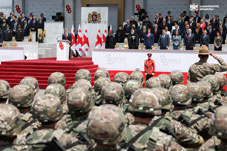
Georgia marked its 108th Independence Day on May 26 with official ceremonies, military oath-taking, and a ceremonial flyover, as the Opposition Alliance announced a large protest march in the capital later in the day.
This year's celebrations carried an additional theme: the 1,700th anniversary of Georgia's adoption of Christianity as the state religion, with government buildings decorated with "1,700" banners and portraits of the late Patriarch Ilia II alongside national flags. Public events were largely confined to Liberty Square and the area surrounding the presidential palace, as Rustaveli Avenue has hosted continuous protests since late 2024.
Georgian Dream-elected President Mikheil Kavelashvili said May 26 was a day that "defines the identity and future" of the Georgian people. He described Georgian statehood as having survived through "faith, identity, traditions, and the preservation of the Georgian language," and stressed the role of the Orthodox Church in preserving national identity. He called on Georgians to honor those who fought for independence and to work toward "a united, prosperous Georgia" together with Abkhazian and Ossetian "sisters and brothers."
Newly enthroned Patriarch Shio III described the Church as "always the spiritual pillar of the Georgian people and the foundation of national unity." He paid tribute to the late Patriarch Ilia II, whose "half-century of work became a vital cornerstone in strengthening the spiritual and civic unity of the nation." He addressed soldiers, telling them that "the strength of an army should be expressed not in the desire for war, but in the preservation of peace," and told younger generations that "genuine freedom is, first and foremost, responsibility, faith in God, inner strength, and an honest and moral life."
Georgian Dream Prime Minister Irakli Kobakhidze said the day was an occasion to reflect on Georgia's "centuries-long struggle for statehood and independence." He said "empires around us rose and fell, yet Georgia has preserved its national identity and independence to this day," attributing this to "God's protection and the Georgian people's faith." He described Georgia as "independent and sovereign as never before," and said the country would "inevitably" reach what he called "the Promised Land: the achievement of all our national goals, and a united, resplendent Georgia."
Georgian Dream Parliament Speaker Shalva Papuashvili described "love of country, fidelity to traditions, and steadfastness of faith" as Georgia's "three supreme treasures" and framed the Georgian state and Church as "the two pillars of the one body called Georgia." He said "some still wish today to bring down our two pillars" and accused unnamed forces of trying to bind Georgia in "a new golden chain" to prevent it from being "an independent state." "This will not work. The will of the Georgian people is firm," he said.
The Opposition Alliance, uniting nine political parties, announced a large Independence Day march starting after 7 pm from Tbilisi State University and ending at parliament, as part of its "national mobilization" campaign launched on March 31. Various civic and activist groups announced they would join. Alliance representatives said both Tbilisi City Hall and the Interior Ministry had rejected their requests to set up a stage or other structures near parliament.
May 26, 1918, saw Georgia's National Council adopt the Act of Independence, establishing the Georgian Democratic Republic, widely regarded as Europe's first Social Democratic rule. The republic was short-lived, collapsing after the Red Army's invasion in 1921, but left a lasting legacy. On April 9, 1991, Georgia declared the restoration of its independence based on the 1918 act. This year's celebrations come amid a prolonged political crisis and widespread international isolation following the Georgian Dream government's democratic crackdown and anti-Western moves.