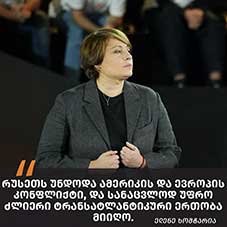
Khoshtaria: NATO Summit in Ankara Produced Concrete Decisions, Not Just Statements
By Messenger Staff
Friday, July 10, 2026
Jailed Droa party leader Elene Khoshtaria has written a letter from the clinic where she is being held, offering her assessment of the recent NATO summit in Ankara. In the letter, she argues that the summit's outcomes go far beyond rhetoric and represent a genuine strategic setback for Russia.
Khoshtaria writes that the alliance responded to the current crisis not with division but with a coordinated push toward concrete action. "NATO managed to take a direction in the crisis not on division or fragmentation, but on very specific, future-oriented actions, which further strengthens this organization," she writes, adding that "the crisis gave impetus to the transition to action."
According to Khoshtaria, the agreements reached in Ankara covered military, political, defense, industrial and economic matters, and were finalized on a timeline unusually fast for international bodies. She says these measures are already having a deterrent effect, making NATO stronger in practical terms today than before the summit.
Khoshtaria also points to a shift in Europe's security architecture, one shaped by the growing weight of regional actors. She names Ukraine as the clearest example of this shift, though she says Turkey's role should not be underestimated either. Both countries, she argues, are becoming central pillars of stability in the Black Sea region, the broader region and Europe as a whole.
On the dynamic between Ukrainian President Volodymyr Zelensky and US President Donald Trump, Khoshtaria describes a marked change in tone. She writes that Zelensky "sat with Trump as an equal partner," noting visible progress in their relationship both in terms of personal rapport and substantive decision-making. She adds that Zelensky used the summit to secure a long-sought goal: a license for Patriot defense systems.
Khoshtaria closes her letter by framing the summit as a series of failures for Moscow's strategic aims. She writes that Russia wanted a fragmented, weakened Europe and Euro-Atlantic space, and instead got one that is more unified. Where Russia sought confusion, she says, it got decisiveness. Where it expected to seize Kyiv within three days, the fighting has since shifted onto Russian territory, aided in part by NATO member states. Attempts to manipulate partners, including Turkey, also failed, with Ankara remaining, in her words, "the axis of Euro-Atlantic security." Finally, she argues that Russia's hopes of driving a wedge between the United States and Europe backfired, producing instead a stronger transatlantic partnership.