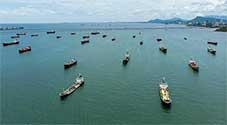
Iran is set to lay out a series of conditions for reopening the Strait of Hormuz, urging all nations to refrain from participating in the strategic economic pressure campaign dubbed "Economic D-Day" by Washington officials.
On Monday, Tehran and Washington exchanged military strikes again for the first time in a month. Late Sunday, the United States launched two attacks on Larak Island to prevent the Iranian military from laying additional mines in the Strait of Hormuz. In retaliation, Tehran launched ballistic missile strikes Monday morning against two U.S. air bases in Jordan, as confirmed by news agency AFP.
On Friday, Mohsen Rezaei, Secretary of Iran's Supreme National Security Council, stated that Iran is developing a list of conditions to reopen the Strait of Hormuz as requested by mediators. News agency Reuters reported that the country has already reached an agreement with Oman regarding a shipping corridor.
Under the agreement, vessels will sail through a "designated central channel," provided the United States meets the conditions proposed by Iran, Rezaei told Al Manar TV in an interview cited by Reuters.
In a statement published August 28 by Iran's Foreign Ministry, the Iranian government condemned the new economic sanctions announced by the United States last Monday, calling them "a new wave of economic terrorism against Iran." The ministry stated that the sanctions violate the UN Charter and put "regional and international peace and security at risk." Citing international law, the statement calls on nations "to refrain from implementing such sanctions."
"Operation Economic Outcast," announced August 24 by the U.S. Department of the Treasury, aims to execute a rigorous economic campaign against the Iranian regime and the Islamic Revolutionary Guard Corps (IRGC) by increasing pressure on entities facilitating sanctions evasion, technology procurement, cyber operations, and other revenue-generating activities, media reported.
"We are now entering the endgame. At dawn begins an economic D-Day-the single greatest financial offensive ever marshaled against an adversary," U.S. Treasury Secretary Scott Bessent declared in a post on X early August 24. He stated that Iran's military capabilities have been shattered and its nuclear program totally destroyed.
As part of the "Operation Economic Outcast" initiative, the Office of Foreign Assets Control (OFAC) has expanded sanctions to block revenue generation tied to the Iranian government, targeting more than 60 entities, individuals, and vessels. Reuters reported that the country's foreign trade has dropped 35%, while the annual inflation rate exceeded 60% last month.
International media report that the U.S. has set deadlines for countries to cease financial transactions with Iran.
Visiting Tehran on Thursday, Qatari Prime Minister Sheikh Mohammed bin Abdulrahman Al Thani said he reiterated during talks the urgent need to reopen the Strait of Hormuz under pre-war conditions.
By Friday, data showed daily ship transits through the Strait dropped below 10, according to Reuters.
Reports this August indicate Iran reached a milestone during negotiations with Oman to normalize traffic through the Strait, with both countries agreeing on specific "geographic coordinates."
Earlier that month, Washington officials expressed hope that negotiations between the two countries would pave the way to resume shipping. However, after the IRGC violated the ceasefire in the Strait of Hormuz, the U.S. government responded with stricter measures.
The critical waterway connecting the Persian Gulf and the Gulf of Oman sits between Iran to the north and Oman to the south, serving as a vital maritime route for several Gulf states.
In peacetime, roughly 130 to 140 vessels transit the waterway daily.
The U.S. and Israel declared war against Iran on February 28. A key sticking point in ongoing peace talks has been the U.S. demand to dismantle Iran's nuclear program and fully remove its stockpiles of highly enriched uranium.
Since February, reported casualties stand at 3,400 on the Iranian side, with 18 U.S. service members killed and more than 700 wounded.