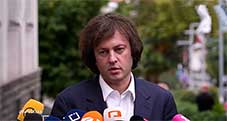
Kobakhidze Says Georgia 'Ahead' of Moldova and Ukraine, Rejects EU Criticism
By Messenger Staff
Thursday, October 8, 2026
Georgian Dream Prime Minister Irakli Kobakhidze said Georgia is ahead of Ukraine, Moldova and other EU candidate countries in most respects, responding to European Commissioner for Enlargement Marta Kos, who said Georgia is an EU candidate country "only on paper" and expressed a wish for Georgia to be "at the same level as Moldova and Ukraine."
"If Moldova and Ukraine are ahead of Georgia in any regard, it is only in terms of negative indicators. God forbid we surpass Moldova and Ukraine in those areas," Kobakhidze said.
He said Georgia had chosen its own path of peace and economic development and would continue along it.
Kobakhidze also dismissed the European Parliament's criticism, saying the institution was "of no interest whatsoever" to him and that everyone knows it has recently disseminated "nothing but falsehoods."
Asked about the EU enlargement document, which makes no mention of Georgia, Kobakhidze said Georgia was "a thousand steps ahead" of Ukraine, Moldova and other candidate countries. He said Georgia had chosen its own path while remaining committed to European integration and called for what he described as a "fair, correct, and sound approach" from the European Commission.
Kobakhidze said Georgia had conscientiously fulfilled its commitments, noting that 90% of the obligations under the EU-Georgia Association Agreement had already been completed. He said the country's European integration would continue without hindrance if the European Commission adopted what he called a sound approach toward Georgia.
"We have clearly stated our policy and intent, which means we will continue on our path toward European integration," Kobakhidze said.
He also commented on an upcoming European Parliament debate titled "Attempts by the ruling party, Georgian Dream, to ban opposition parties in Georgia."
Kobakhidze said attempts to politicize court cases directly contradict the principle of the rule of law. He accused a European institution of attempting to exert political influence over a court decision and said such interference, particularly in the work of Georgia's Constitutional Court, was impermissible.
"It is a tragic development when a specific European body fails to grasp this. They are attempting to exert political influence on a court decision. Of course, they will not succeed, but they fundamentally fail to understand that political interference, especially in the work of the Constitutional Court, is impermissible," he said.