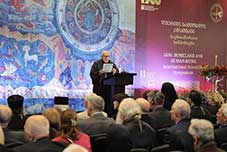
Symposium Opens in Tbilisi to Mark 1,700 Years of Christianity in Georgia
By Messenger Staff
Tuesday, October 13, 2026
An international symposium marking 1,700 years since Georgia adopted Christianity opened in Tbilisi on October 11, bringing together representatives of the Georgian Dream government, the Orthodox Church, academic institutions and foreign church delegations to discuss the country's Christian heritage and its role in shaping Georgian identity.
The multi-day symposium, titled "God, Homeland, Human Being," is dedicated to examining the historical, cultural and spiritual significance of Christianity in Georgia and its contribution to world civilization.
Patriarch Shio III opened the event, followed by speeches from Georgian Dream Prime Minister Irakli Kobakhidze, President Mikheil Kavelashvili and Parliament Speaker Shalva Papuashvili. The symposium is chaired by Roin Metreveli, president of the Georgian National Academy of Sciences.
In his address, Shio III spoke about Christianity's central role in shaping Georgian culture, history and national identity. He also discussed the challenges posed by rapid technological development, saying progress should serve humanity rather than undermine faith and human values.
The Patriarch paid tribute to the late Patriarch Ilia II and offered prayers for people living in Abkhazia and the Tskhinvali region, as well as for Georgians living abroad.
Kavelashvili proposed bringing together two formulations of Georgian national values, "God, Homeland, Human Being" and "Fatherland, Language, Faith," in a broader seven-part formula that also includes family. The latter expression is associated with Georgian public figure and writer Ilia Chavchavadze, while "God, Homeland, Human Being" was introduced by the late Patriarch Ilia II.
Kavelashvili said these values were important for preserving Georgia's national identity amid globalization and rapid technological change, including the growing influence of artificial intelligence.
Kobakhidze pledged continued cooperation between the government and the Orthodox Church, describing the Church as a longstanding pillar of Georgia's spiritual life and national unity. He stressed the importance of the Church's role in the country's history and in preserving its cultural traditions.
Papuashvili spoke about the importance of national identity in Georgia's historical development, saying that the preservation of the country's language, faith and traditions had helped Georgians endure periods when the country lost its statehood.
The anniversary symposium brings together clergy, historians, researchers and representatives of religious institutions to discuss Christianity's influence on Georgia's development and its place in the country's cultural and spiritual heritage.