Georgian Dream Responds to Exclusion From EU Enlargement Forum
By Messenger Staff
Wednesday, November 11, 2026
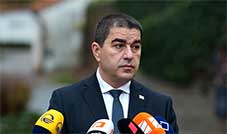
Senior Georgian Dream officials responded sharply to the European Commission's confirmation that Georgia had not been invited to next week's Enlargement Forum. Parliament Speaker Shalva Papuashvili said Georgia would not attend meetings where the invitation is not extended at the appropriate level and accused Brussels of identifying with Soviet Moscow, while Tbilisi Mayor and party General Secretary Kakha Kaladze said partnership with Europe must be reciprocal.
Commission spokesperson Guillaume Mercier had confirmed that Georgia was not invited to the forum. He added that the Georgian authorities had been invited to a second meeting, a ministerial meeting on connectivity issues, but at a lower level of representation.
"If the invitation is not extended at the appropriate level, we will not participate in such meetings," Papuashvili said.
He accused the Commission of a "dismissive attitude" that, in his words, showed it identifies itself with Soviet Moscow. "Of course, this amounts to a decision to invite us at a lower level," he said. "More broadly, it demonstrates the immaturity of the EU bureaucracy."
Papuashvili also took aim at the way the Middle Corridor was being discussed. "It is simply ridiculous when they talk about the Middle Corridor," he said. "Are they supposed to fly over Georgia, jump over it, or what exactly are they supposed to do? I cannot imagine."
The Speaker said the treatment was disrespectful to the Georgian people, their sovereignty and the country's independence. "This is how Moscow used to treat us, and now Brussels is repeating the steps of Soviet Moscow," he said, adding that the Commission should no longer take offence at the comparison. "By looking down on us and adopting such an arrogant attitude, they are identifying themselves with Soviet Moscow."
Speaking to journalists in response to a question about the country not being invited to the EU enlargement summit, Kaladze said the government has repeatedly signalled its readiness to turn a new page in relations with Europe, but not at the expense of Georgian interests.
"The Georgian government has repeatedly signaled its readiness to turn a new page in its relations, but not in a way that compromises our interests or allows major powers to use us to advance their own agendas," he said. "That simply won't work."
Partnership and friendship must be reciprocal, Kaladze said, rather than a dynamic defined by "looking down on someone, issuing orders, and expecting them to be carried out."
"Why do we want Europe?! Our primary goal was freedom," he said. If Brussels keeps issuing directives that are known from the outset to be harmful and problematic for the country, he said, "a sensible leader, one who defends their nation's interests and cares for their people, certainly should not take such a step."
As an example, he cited the possibility of joining sanctions. "We know full well that this would be damaging to the economy and to ordinary citizens, don't we?" he said. He added that there were many other such issues, including those related to legislation.
Kaladze accused European officials of double standards on "transparency." They forbid, threaten and blackmail Georgia, he said, demanding that it not take certain actions or asking why it adopted a particular law, "yet they end up doing the very same thing themselves." The public, he said, can easily form its own assessment of these matters, "especially regarding the decisions coming from high-ranking European officials."