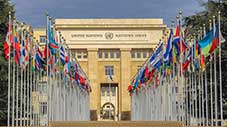
Geneva Talks End Without Discussion of Displaced Persons' Return After Walkout
By Messenger Staff
Friday, November 13, 2026
The 68th round of the Geneva International Discussions (GID) took place on November 10-11 without any discussion of the return of internally displaced persons and refugees, the talks' core agenda item, after some participants walked out.
"The core agenda item 'returns' of internally displaced persons and refugees was not discussed during this round, due to a walkout by some participants," the co-chairs said in a joint communiqué. They referred to the established practice of representatives of Russia and the occupation regimes, and called on all participants to engage on every agenda item.
The GID was set up under the EU-brokered ceasefire agreement of August 12, 2008. It is co-chaired by the OSCE, the EU and the UN and brings together Georgia, Russia, the US, Georgian exiled administrations and the Russian-backed authorities of Abkhazia and the Tskhinvali region.
The co-chairs said participants welcomed the talks as "a unique platform for dialogue." On security, they noted "diverging assessments" of the situation but also "the absence of major security incidents over the past few months." Participants held an "in-depth discussion" on non-use of force and security arrangements, praised the Ergneti Incident Prevention and Response Mechanism (IPRM) and its EUMM hotline, and reiterated support for resuming the Gali IPRM. The humanitarian group covered crossings, documentation, livelihoods, missing persons, education and freedom of movement.
The Russian Foreign Ministry called the GID "the only format" for post-conflict relations and demanded "legal guarantees of Tbilisi's non-use of force" against the two regions, a "process of border delimitation" and the resumption of the Gali IPRM. It cited "persisting risks" to their "independence" from "radical forces in Georgia" and NATO member states. Moscow also said it continues to seek moving the talks to "another, truly neutral venue," accusing Switzerland of abandoning neutrality by joining EU sanctions.
The Tskhinvali delegation, led by First Deputy de facto Foreign Minister Andrey Tskhovrebov, called the occupation line "relatively calm" and backed continued work on a non-use of force document. It accused Georgian authorities of "sabotage" in the investigation into the alleged "enforced disappearance" of three "South Ossetian" citizens, and said talks on displaced persons could resume only if Georgia ends their "artificial politicization."
The Abkhaz delegation pressed for a legally binding non-use of force guarantee and said it wants the Gali IPRM, suspended since 2018, restored. It also alleged Georgian pressure on Abkhaz athletes at events in Turkey and Spain, and threats against Adnan Menderes University associate professor Elchin Adzinba after her speech at the UN Forum on Minority Issues in Geneva.