Oil prices have declined significantly in recent weeks, with analysts expecting a further fall by 2027.
A report released on Friday by the International Energy Agency (IEA) said that North Sea Dated crude oil prices had decreased by 32%, from USD 136 per barrel in early October to USD 93 per barrel at the time of the report's publication, "as a sustained recovery in Gulf exports eased market tightness." Diesel prices in Europe also fell by 11% to approximately USD 180 per barrel, although they remained 77% above pre-war levels.
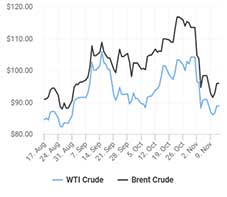
According to historical market data, WTI crude oil prices fell by approximately 15% over the past two weeks, from USD 104.12 per barrel on October 30 to USD 88.56 per barrel on Friday, November 13. WTI crude oil prices fluctuated within a range of USD 87.80 to USD 89.64 per barrel on Friday.
The escalation of conflicts in the Middle East has contributed to a surge in oil prices, with WTI rising from around USD 60 per barrel at the beginning of the year to as high as USD 114 in April. Oil prices continued to fluctuate throughout the year. On September 15, WTI crude oil reached USD 105.83 per barrel before rising again to approximately USD 105 per barrel at the end of October.
Brent crude also recorded significant price increases, reaching USD 108.75 per barrel in mid-September and USD 116.72 in the second half of October. However, a gradual decline has been observed since October, with Brent crude settling at USD 95.84 per barrel on Friday.
International Monetary Fund (IMF) estimates, based on Brent crude futures contracts and market expectations regarding developments in the Middle East, project prices for the Brent benchmark to fall to approximately USD 86 per barrel next year, according to Report.az. The publication quoted Roberto Cardarelli, Deputy Director of the IMF's Middle East and Central Asia Department, as saying that the Fund expects the average oil price to remain at approximately USD 96 per barrel in 2026.
In a report published on November 13, the International Energy Agency forecast that global oil demand would fall by 2.7 million barrels per day to 102.3 million barrels per day in 2026, before rebounding by 2 million barrels per day in 2027, provided that Gulf exports continue to recover. The agency stated that the global oil market is projected to return to a surplus in the fourth quarter of the year for the first time since the outbreak of the war in Iran.
The report also stated that global refinery runs fell by 1.3 million barrels per day to a seasonal low of 81.3 million barrels per day in October and are forecast to rebound to 84.7 million barrels per day in December. Global refinery throughput is projected to increase by 2.5 million barrels per day to 84.3 million barrels per day in 2027, following an average annual decline of 2.2 million barrels per day in 2026.
The recent changes in oil prices have been influenced by developments in the Middle East, particularly the disruption and subsequent recovery of energy exports from the Gulf region, as well as supply disruptions elsewhere.