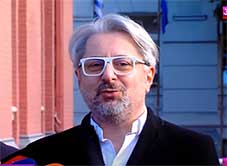
Gvaramia Says He Does Not Recognize Kavelashvili as Legitimate President but Considers Constitutional Court Legitimate
By Messenger Staff
Thursday, November 19, 2026
Nika Gvaramia, leader of the Coalition for Change, said he does not recognize Mikheil Kavelashvili as a legitimate president but considers the Constitutional Court a legitimate judicial body, during a hearing in the case seeking to ban several opposition parties.
The exchange followed questions from Georgian Dream representatives about whether Gvaramia considers Georgia's current Parliament, President, Government and Constitutional Court legitimate.
Gvaramia said legitimacy was not solely a legal matter but also had a political dimension. He said he did not recognize the current Parliament or consider it his government, but stressed that this did not mean he refused to obey laws passed by it.
"I do not consider Parliament legitimate, which is also my political assessment. Legitimacy is not only a legal component; it is primarily political," he said, adding that he continued to comply with Georgian law despite not recognizing the authorities politically.
Gvaramia also questioned the legitimacy of the process through which the current Constitutional Court was formed, saying he did not believe any of its members had been elected by the current Parliament. However, he distinguished his political assessment of the authorities from the legal status of the court, saying he considered it a legitimate judicial body.
Georgian Dream representative Tornike Cheishvili pointed out that some Constitutional Court judges had been appointed by Kavelashvili. Another ruling party representative, Archil Gorduladze, then asked whether Gvaramia considered those appointments illegitimate because he did not recognize the president.
In response, Gvaramia said Kavelashvili's lack of legitimacy in his view did not invalidate every decision made by him. He cited presidential pardons, arguing that people who had been pardoned should not be returned to prison simply because he considered the president illegitimate.
"I am standing here because I believe the Constitutional Court is a legitimate judicial body," Gvaramia said.
He also argued that disputes over the legitimacy of state institutions were irrelevant to the legal question of banning political parties, stressing that refusing to recognize a government politically was not the same as refusing to comply with the country's laws.